Hsin Tung Yang Uses AI to Make ESG Information Easier

- Copied



2026.09.17
ESG News
Hsin Tung Yang Uses AI to Make ESG Information Easier
Hsin Tung Yang began with the needs of everyday users, transforming its 100-plus-page 2025 Hsin Tung Yang Sustainability Report into an AI-powered service that people can search and ask questions.
Users do not need to understand ESG terminology. They can simply ask questions in everyday language and quickly learn about Hsin Tung Yang’s work in food safety, environmental management, supply chain management, employee well-being, and social engagement.
Why Did Hsin Tung Yang Start Using AI for Sustainability Information?
For people who want to understand how seriously a company takes sustainability, its sustainability report is usually the most comprehensive source of information. However, a report running over 100 pages can contain large amounts of data, policies, systems, and technical terminology, making it difficult to read in a short amount of time.
Users may not know which section contains the information they need or which keywords to search for. That is why Hsin Tung Yang chose its corporate sustainability website as the starting point for AI adoption.
The goal is to let people ask questions in their own words, such as:
- How does Hsin Tung Yang ensure food safety?
- What is a Green Factory?
- How does Hsin Tung Yang conserve water and energy?
- How does Hsin Tung Yang support its employees?
- What social initiatives does Hsin Tung Yang take part in?
The AI organizes its answers based on officially disclosed sustainability information, helping users find relevant content more quickly. They do not need to read the entire report first or have a professional background in ESG.
As Hsin Tung Yang approaches its 60th anniversary, adopting AI is about more than introducing a new digital tool. It is also an opportunity to create a more accessible and modern way of communicating while continuing to build on the company’s longstanding commitment to food safety, quality, and trust.
How Is the AI Sustainability Service Designed Around Users?
When planning its AI sustainability service, Hsin Tung Yang did not begin by asking how much new technology it could add. Instead, it started with a more fundamental question: What difficulties do people face when trying to understand sustainability information?
The user experience was designed around four goals: making information easy to find, easy to understand, trustworthy, and worth exploring further.
Easy to Find
Users can ask questions by text or voice. They do not need to understand complex ESG categories or search through a 100-plus-page sustainability report one page at a time.
The question-and-answer format reorganizes information that was originally spread across different sections according to what users actually want to know, making it easier to find relevant content.
Easy to Understand
The AI explains sustainability topics in clear, concise, and everyday language, while avoiding unnecessary technical terms.
When a concept is more complex, the AI presents it in a way that is easier for the general public to understand without changing the meaning of the original information. This helps people of different ages and backgrounds grasp the key points.
Trustworthy
The AI sustainability service uses the 2025 Hsin Tung Yang Sustainability Report and other verified public information as its primary knowledge sources. Whenever possible, its answers identify the reporting year, scope of the data, and original source.
Hsin Tung Yang wants users to do more than receive a quick answer. They should also be able to see where the information comes from and understand the broader context behind the data and explanations.
Worth Exploring Further
The AI does more than provide a short answer. It also helps users find related website content or relevant sections of the sustainability report, allowing them to explore the background and full details.
The ideal experience is not for users to leave after asking one question. Instead, each question should help them gradually discover the sustainability topics they genuinely care about.
How Were the AI Virtual Spokesperson’s Image and Speaking Style Chosen?
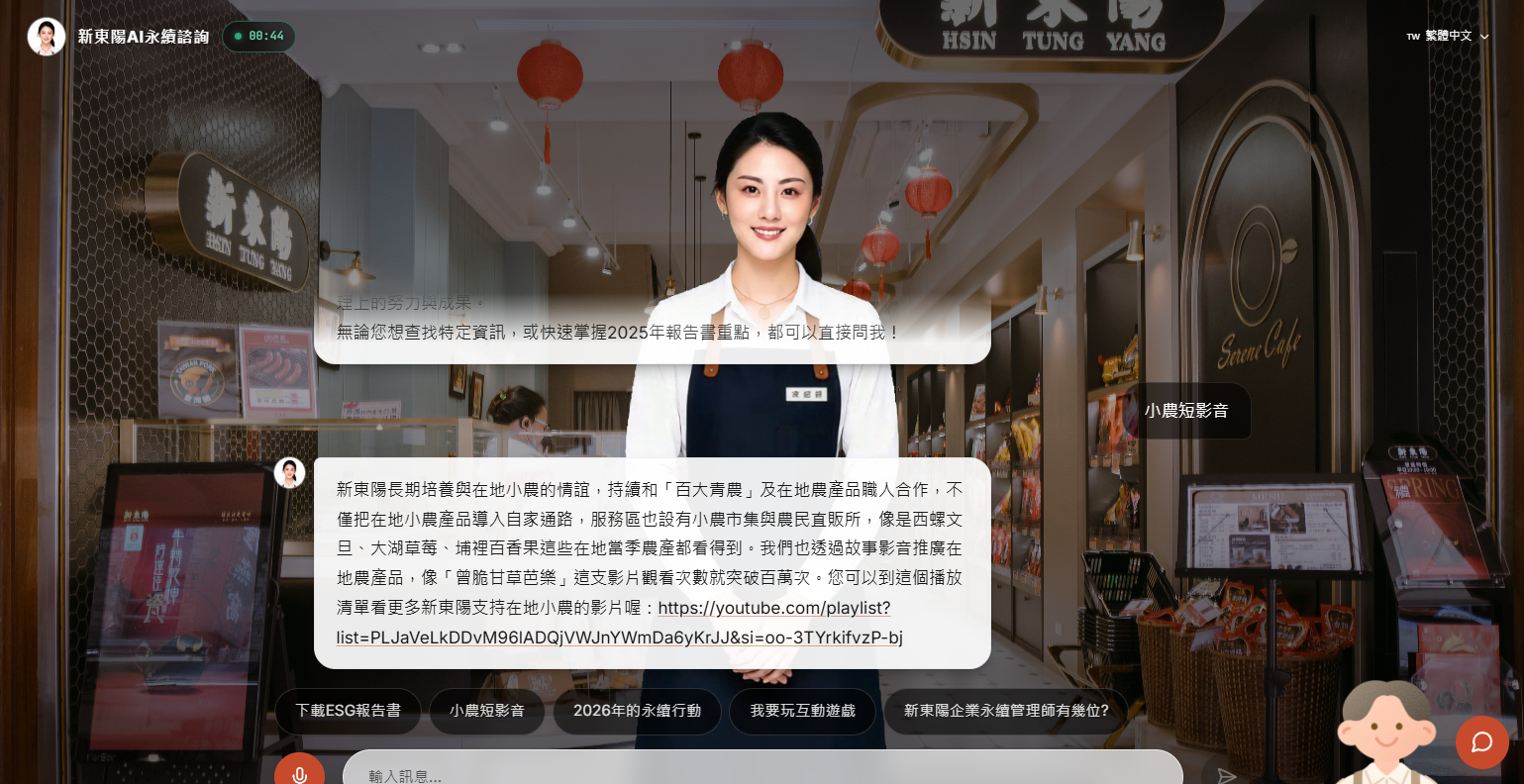
Hsin Tung Yang based its AI virtual spokesperson on Cindy Shen (宋紀妍), who has represented the brand for many years. The familiar image is intended to make new technology feel more approachable to everyday users.
Cindy Shen has appeared on in-store displays and across other brand communication channels. Building on this familiar identity helps create an experience that feels friendly, clear, and trustworthy while keeping the AI sustainability service consistent with Hsin Tung Yang’s established brand image.
The virtual spokesperson’s voice, pace, and speaking style are designed to be easy for people of different age groups to understand. Instead of using dense ESG terminology, the virtual spokesperson explains complex information in more familiar language when needed, making sustainability content easier to follow.
The website will also clearly state that the video and audio are generated using AI technology and that the answers are produced automatically by AI. The virtual spokesperson’s hairstyle, clothing, and other visual details will be appropriately differentiated from Cindy Shen’s real-life spokesperson image, helping users clearly recognize that they are interacting with AI.
For Hsin Tung Yang, creating a friendly experience does not mean obscuring the AI’s identity. Helping users recognize the technology, make informed choices, and understand the source of the information is also an important part of human-centered design.
How Does AI Extend Sustainability Communication Beyond the Materiality Survey?
The materiality survey is an important tool that helps Hsin Tung Yang understand the sustainability issues its stakeholders care about. However, surveys are generally conducted during a defined period and use a predetermined set of questions. This makes it more difficult to capture what people genuinely want to ask in everyday situations or where they encounter difficulties understanding sustainability information.
The AI sustainability service helps fill this gap. Instead of choosing from a fixed set of answers, users can ask questions in their own words and continue the conversation based on their interests. This allows them to explore topics such as food safety, environmental management, supply chains, employee well-being, and social engagement in greater depth.
The AI service is not intended to replace the materiality survey. It provides an additional communication channel that remains available throughout the year. This allows Hsin Tung Yang to continue formally gathering stakeholder feedback through regular surveys while also gaining a better understanding of the public’s everyday information needs and reading habits.
Hsin Tung Yang will not evaluate the service solely by the number of users, questions, or AI-generated answers. More importantly, the company will consider whether users genuinely find the service helpful, including:
- Whether users can quickly find the AI sustainability service.
- Whether the answers are clear, easy to understand, and relevant to the questions.
- Whether users need to repeatedly rephrase the same question.
- Whether answers provide accurate and verifiable sources.
- Whether users continue asking questions after receiving an initial answer.
- Whether users visit related webpages or read the original sustainability report.
Subject to privacy and personal data protection requirements, Hsin Tung Yang will also use anonymized information to understand which sustainability topics people care about most, where conversations tend to end, and which content is more difficult to understand. These insights will help improve the website, its knowledge content, and the overall user experience.
In the past, companies could often only see how many times a sustainability report had been downloaded or use materiality surveys to understand stakeholder views during a specific period. Through AI consultation, Hsin Tung Yang hopes to gain a deeper understanding of what people want to know in their everyday lives, where they encounter difficulties, and whether the website genuinely helps them find answers.
By moving from periodic surveys to year-round interaction, Hsin Tung Yang aims to make sustainability communication more than one-way disclosure or a one-time collection of feedback. The goal is to gradually create an ongoing cycle of listening, responding, and improving.
Using AI to Make Sustainability Information Easier to Understand
Publishing information on a website does not necessarily mean that everyone can easily find or understand it.
Hsin Tung Yang introduced its AI sustainability service to narrow the distance between corporate sustainability information and everyday users. People of different ages, backgrounds, and levels of knowledge can explore sustainability in a way that feels familiar and accessible to them.
This service is more than a chatbot added to a website. It is intended to gradually transform an annual, static sustainability report into a year-round information gateway that people can search, ask questions about, and understand.
AI is not the goal. It is a tool that helps people access and understand information. For Hsin Tung Yang, the most meaningful result is not how many questions the AI answers, but whether users can find information more easily, understand it more clearly, and feel encouraged to learn more about the company’s sustainability actions.
Frequently Asked Questions
Why Did Hsin Tung Yang Start Using AI on Its Corporate Sustainability Website?
Hsin Tung Yang’s sustainability report runs over 100 pages and covers corporate governance, food safety, supply chains, environmental management, employee well-being, and social engagement. The AI sustainability service lowers the barriers to searching and reading this information, allowing the general public to find relevant content quickly using everyday language.
What Questions Can Hsin Tung Yang’s AI Sustainability Service Answer?
The service currently focuses on sustainability information officially disclosed by Hsin Tung Yang, including corporate governance, food safety, supply chains, environmental management, employee well-being, and social engagement.
Do Users Need to Understand ESG Terminology Before Using the Service?
No. Users can ask questions in everyday language or in whatever way feels natural to them. The AI then organizes the relevant information based on their questions.
Where Do the AI Sustainability Service’s Answers Come From?
The service primarily uses the 2025 Hsin Tung Yang Sustainability Report and other verified public information as its knowledge sources, helping users understand sustainability information that has already been officially disclosed.
Are Users Speaking with a Real Person?
No. The website clearly states that the video and audio are generated using AI technology and that the answers are automatically generated by AI, allowing users to recognize the virtual spokesperson’s AI identity.
Will the AI Sustainability Service Replace the Materiality Survey?
No. The materiality survey remains an important tool for formally gathering stakeholder feedback. The AI sustainability service provides an additional year-round communication channel that captures the questions and information needs people have in everyday situations.
How Will Hsin Tung Yang Evaluate the AI Sustainability Service?
Hsin Tung Yang will look at whether users can find the service quickly, understand the answers, access verifiable information, and feel encouraged to continue asking questions or reading related content. Evaluation will not be based solely on user numbers or the number of questions submitted.
- Copied